
Table of Contents
- Introduction
- The Evolution of Font Design
- What Makes Human-Crafted Fonts Unique?
- How Machine-Generated Fonts Work
- Human vs Machine: Key Differences in Typography
- Where AI Excels — and Where It Still Struggles
- Font Examples from RaisProject: Human Touch vs Machine Precision
- What the Future of Typography Might Look Like
- Conclusion
- References
1. Introduction Human vs Machine Font
Human vs Machine Font has already transformed many creative industries — and typography is no exception. AI-powered tools can now generate typefaces in seconds, analyze thousands of styles, and even mimic visual patterns from existing designs.
But one question keeps emerging:
“Will machine-generated fonts replace human designers?”
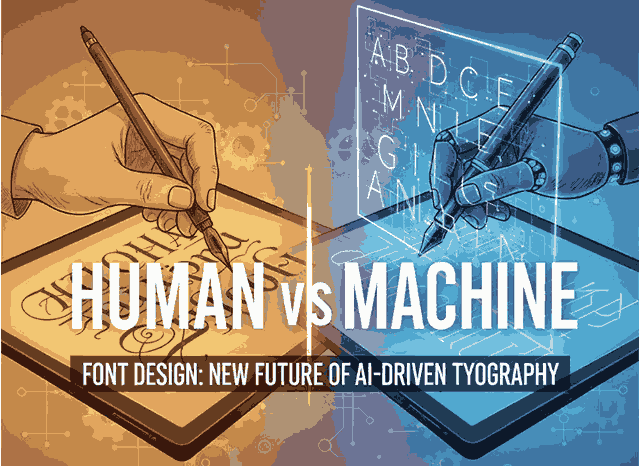
This article explores the Human vs Machine debate in typography, analyzing emotional depth, artistic integrity, and creative decision-making. We also include curated examples from RaisProject, highlighting how fonts reflect either human expression or machine-like precision.

2. The Evolution of Human vs Machine Font Design
Typography has always been shaped by technology:
- Metal movable type → handcrafted precision
- Phototypesetting → industrial efficiency
- Digital typography → unlimited creative freedom
- AI typography → automated design generation
As technology evolves, designers adapt — but one thing remains constant: fonts are vehicles for human communication. They carry emotion, culture, and meaning.
3. What Makes Human vs Machine Font Unique?
Human designers create typefaces with intention. Their decisions are influenced by:
1. Emotion and Storytelling Human vs Machine Font
Humans infuse personality and narrative into each curve, stroke, and serif.
2. Cultural Context Human vs Machine Font
Designers draw from history, tradition, and visual heritage.
3. Imperfection as Identity Human vs Machine Font
Small inconsistencies make a font feel warm and authentic.
4. Creative Intuition
Humans understand nuance — when a letter feels “too stiff,” “too heavy,” or “not friendly enough.”
These qualities are difficult for AI to replicate.
4. How Human vs Machine Font – Generated Fonts Work
AI generates fonts through algorithms that analyze thousands of existing typefaces. These systems:
- Identify common patterns
- Predict stylistic variations
- Reproduce consistent shapes
- Create entirely new combinations
AI excels at speed, precision, and pattern recognition, but lacks emotional intelligence.
Machine-generated fonts are highly efficient, but sometimes lack soul.
5. Human vs Machine Font: Key Differences in Typography
| Aspect | Human Designers | AI / Machine |
|---|---|---|
| Creativity | Emotional, intuitive, expressive | Pattern-based, analytical |
| Consistency | Slight imperfections | Perfect mathematical precision |
| Speed | Slow, thoughtful | Instant |
| Originality | Deeply inspired by culture & experience | Risk of similarity or style-copying |
| Emotional Tone | Strong and intentional | Often neutral or generic |
| Adaptability | Context-aware | Data-dependent |
Both have strengths — the future likely blends the two.

6. Where AI Excels — and Where It Still Struggles
AI Strengths Human vs Machine Font:
- Rapid generation of font concepts
- Perfect geometric consistency
- Helpful for prototyping
- Useful for large-scale visual systems
- Great at analyzing typographic rules
AI Weaknesses Human vs Machine Font:
- Cannot understand cultural symbolism
- Lacks emotional sensitivity
- Struggles with expressive or handcrafted styles
- Cannot judge aesthetic beauty beyond data
- May create designs lacking originality
Typography is not just geometry — it is communication.
7. Font Examples from RaisProject: Human vs Machine Font
Here are four RaisProject fonts chosen to illustrate the contrast between human-made expressiveness and machine-like precision.
1. Longless Font — Futuristic Machine Precision
The Longless font represents sleek digital aesthetics. Clean lines and geometric shapes embody the “machine side” of font design, ideal for tech branding, futuristic interfaces, and AI-driven environments.
2. Legendry Brush Font — Human Expression & Emotion
Legendry carries dramatic brush textures that only a human hand can create. The strokes feel raw, emotional, and imperfect — a true representation of human creativity and artistic intuition.
3. The Ruler Font — Precision Meets Personality
The Ruler sits in the middle of the spectrum: structured and measured like a machine, yet warm and creative like a human designer. This hybrid style showcases how technology and craftsmanship can coexist.
4. Space Power Font — Ultra-Modern, Machine-Like Aesthetics
Space Power strongly represents AI-driven or sci-fi typographic styles. Its futuristic shapes, sharp edges, and digital proportions make it ideal for technological and space-themed designs.
8. What the Future of Typography Might Look Like
AI will not replace type designers — it will transform their roles.
Future Possibilities:
- Designers become art directors for AI tools
- AI assists in rapid prototyping
- Humans focus on storytelling & emotional depth
- Greater collaboration between algorithms and intuition
- Hybrid fonts inspired by both human artistry and machine precision
Typography is evolving — not disappearing.
9. Conclusion Human vs Machine Font
The debate between Human vs Machine Font Design is not about competition — but collaboration. AI brings speed and mathematical perfection, while humans bring meaning, humanity, and emotional intelligence. The strongest typography of the future will blend both worlds.
RaisProject’s font collection demonstrates this balance perfectly, showing how expressive brush scripts and futuristic sans serifs can coexist in today’s design landscape.
Typography is not ending — it is expanding.
10. References
- Letterhend Studio — AI in the World of Fonts: Is This the End for Typography Designers?
- Canva — Font Psychology & Typography Guides
- 99Designs — Typography Articles
- Typewolf — Font Guides