
Table of Contents
- Introduction
- What Is Brain-to-Text Technology?
- How Brain-to-Text Will Transform Typography
- Neural Interfaces and Real-Time Font Generation
- The Role of AI in Brain-Driven Typography
- Benefits and Challenges of Brain-to-Text Font Creation
- Potential Uses in Design, Education, VR, and Accessibility
- Futuristic Fonts That Align With Brain-to-Text Concepts (Examples from RaisProject)
- What Typography Might Look Like in 2050
- Final Thoughts
- References
1. Introduction Brain-to-Text Font Generation
Brain-to-Text Font Generation Typography is evolving faster than ever as technology pushes creative boundaries. One of the most exciting upcoming innovations is Brain-to-Text Font Generation—a futuristic concept where fonts can be created, modified, or generated directly from neural activity. Instead of using keyboards or design software, designers could one day think a font into existence.
While this technology is still under development, advances in AI language modeling, neural decoding, and brain-computer interfaces (BCIs) show us that this future may arrive sooner than expected. In this article, we explore how brain-to-text will reshape typography, how it works, and which modern futuristic fonts can visually represent this next evolution in design.
2. What Is Brain-to-Text Font Generation Technology?
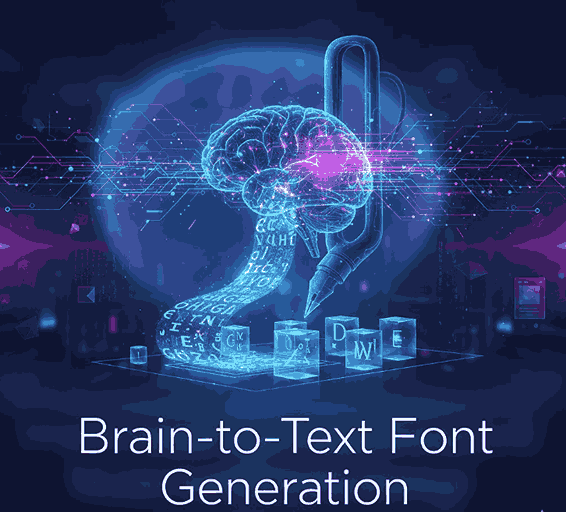
Brain-to-text refers to a neurotechnology system that decodes human thoughts, neural signals, or imagined pen strokes and converts them into readable digital text. Advances in companies like Neuralink, Meta AI, and various neuroscience labs show rapid progress in:
- Neural signal decoding
- Thought-to-text reconstruction
- Imagined handwriting detection
- Speech synthesis from brain waves
This technology aims to help people communicate through thought alone—but it also opens massive new possibilities for designers.
3. How Brain-to-Text Font Generation Will Transform Typography
Typography today requires manual input using:
- Design software
- Typing tools
- Hand-lettering
- Digital editing
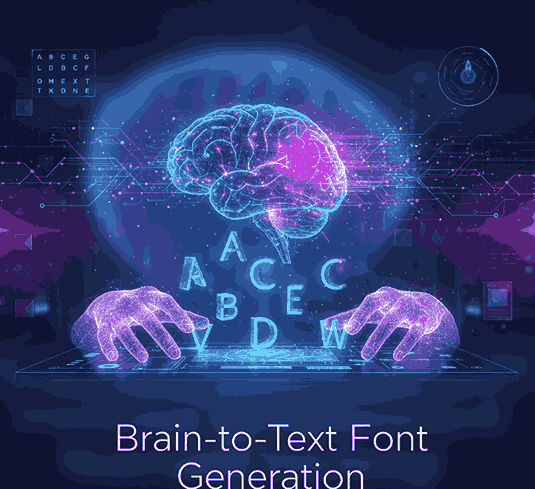
But brain-to-text systems could elevate typography by enabling mental font design, where the user visualizes the font style and the system renders it instantly.
Potential transformations include:
• Instantly generating fonts from imagination
Imagine thinking of a rounded, neon, cyber-inspired sans serif—and seeing it appear on the screen in seconds.
• Emotion-driven typefaces Brain-to-Text Font Generation
Fonts could adjust to mood, brainwave patterns, or cognitive states.
• Hyper-personalized typography Brain-to-Text Font Generation
Every designer could create signature typefaces based on brain patterns, much like fingerprint-style identity.
• Faster workflow for digital artists Brain-to-Text Font Generation
Brain-directed drafts could eliminate early sketching or prototyping.
This shift merges creativity with neuroscience, forming a new category: neuro-typography.
4. Neural Interfaces and Real-Time Brain-to-Text Font Generation
Brain-to-text font generation relies on Brain-Computer Interfaces (BCIs)—devices that translate neural activity into digital commands.
There are two key methods:
1. Non-invasive BCIs
Uses EEG or optical sensors to interpret brain activity externally.
Future versions could translate mental sketches into font outlines.
2. Implantable BCIs
Like those developed by Neuralink and clinical research labs.
These offer higher precision and could support real-time font creation with near-zero latency.
A designer simply imagines a stroke, style, weight, or curvature—and the AI reconstructs it as typography.
5. The Role of AI in Brain-Driven Typography
AI is the backbone of brain-to-text font generation.
AI systems analyze patterns related to:
- Stroke direction
- Pressure simulation
- Spacing
- Weight
- Emotional tone
- Artistic intention
Using neural inputs, AI could create fonts that are:
- Clean and geometric
- Complex and futuristic
- Organic and expressive
- Multi-dimensional (3D, holographic, animated)
AI ensures that the generated typeface is structured, readable, and visually cohesive.
6. Benefits and Challenges of Brain-to-Text Font Creation
Benefits
✔ Hyper-fast creative output
✔ Accessibility for disabled designers
✔ Limitless creative freedom
✔ Personal artistic signature embedded in fonts
✔ Revolutionary workflows for branding, gaming, VR, and UX
Challenges
⚠ Accuracy and neural misinterpretation
⚠ Ethical concerns of thought privacy
⚠ High dependence on AI correction
⚠ Potential IP disputes (Who “owns” a thought-generated font?)
⚠ Accessibility gap between users with and without BCI devices
Despite these challenges, the creative possibilities remain massive.
7. Potential Uses in Design, Education, VR, and Accessibility
Brain-to-text typography can impact multiple fields:
• Graphic Design & UI
UX designers could instantly prototype font variations for apps, dashboards, or holographic displays.
• VR and AR Worlds
Fonts generated by thought could react dynamically to user perspective, motion, or emotion.
• Advertising
Marketers could create conceptual typefaces that adapt to audience engagement patterns.
• Education
Students with disabilities could produce written material with greater ease.
• Accessibility
People with paralysis or speech impairments could regain communication through neural typing.
8. Futuristic Fonts Aligned With Brain-to-Text Font Generation Concepts
Here are modern font examples from RaisProject that visually represent futuristic, neural-driven, or technological typography.
1. Enclave Font
A clean, futuristic sans serif with strong sci-fi styling.
2. Longless Font
Minimalistic, rounded, and futuristic—perfect for UI and next-gen digital interfaces.
3. Space Power Font
Bold, geometric, and outer-space inspired; ideal for future tech and AI branding.
4. Evolutionary Font
A modern, sharp sans serif inspired by technological progress and innovation.
These fonts help readers visualize how typography might evolve in a world where imagination becomes the primary design tool.
9. What Typography Might Look Like in 2050
By 2050, typography could include:
- Neural-responsive typefaces
- Fonts that adapt to user thoughts or emotions
- Holographic or multi-layered 3D text
- Energy-efficient “eco-fonts”
- Fonts dynamically generated by AI using user brain signals
- Cybernetic calligraphy created from mental gestures
Typography itself may transform into a living, adaptive system—not just a visual asset.
10. Final Thoughts Brain-to-Text Font Generation
Brain-to-Text Font Generation isn’t just a futuristic concept—it represents a new era where imagination becomes the direct input tool for creativity. By merging neuroscience, AI, and typography, designers will unlock artistic potential never seen before.
And while we wait for neural-driven design to arrive, futuristic fonts like Enclave, Longless, Space Power, and Evolutionary from RaisProject offer a glimpse of what tomorrow’s typography could look like.